QD-EL

Quantum-Dot Electroluminescence: A Cost-Efficient Successor to OLED

This is a sponsored post by QNA Technology

Cost and performance could make QDEL technology a real competitor to OLED. A potential scenario? Notebooks will adopt it first, followed by TVs and perhaps smartphones. Implementing this technology is relatively straightforward, provided blue quantum dots help the industry achieve its desired lifespan goals. This is an opportunity for Europe, which has blue quantum dots know-how and product at home (QNA Technology, Poland).

Low-Cost Production, High Performance

Quantum-Dot Electroluminescence (QDEL) represents a major evolution in emissive display technology, relying on electrically stimulated quantum dots (QDs) rather than photoluminescent down-conversion. QDEL’s core advantage lies in its solution-processed manufacturing—using coating, lithography, etching (C+L+E), or inkjet printing (IJP)—instead of vacuum thermal evaporation (VTE), which dominates OLED fabrication. 

Read the full story Posted: Oct 21,2025

SDC shows a cadmium-free QD-EL display prototype with a brightness of 400 nits

Samsung Display is showing a range of new OLED and microLED display prototypes at Displayweek 2025, and it also unveiled a new cadmium-free QD-EL device, which uses quantum dots as the emissive materials. The latest prototype from Samsung offers a 264 PPI resolution and 400 nits of brightness. 

Samsung QD-EL display prototype at Displayweek 2025

Samsung says that this panel has the highest luminance among all QD-EL prototypes disclosed to date. Samsung says that it managed to dramatically increase the lifetime of the blue QD emitting material.

Read the full story Posted: May 13,2025

Samsung aims to commercialize QD-EL display in the next few years, to accelerate its R&D

According to reports from Korea, Samsung Electronics has decided to accelerate the development of its QD-EL display technology. Working together with its affiliate companies, Samsung aims to commercialize QD-EL displays within the next few year.

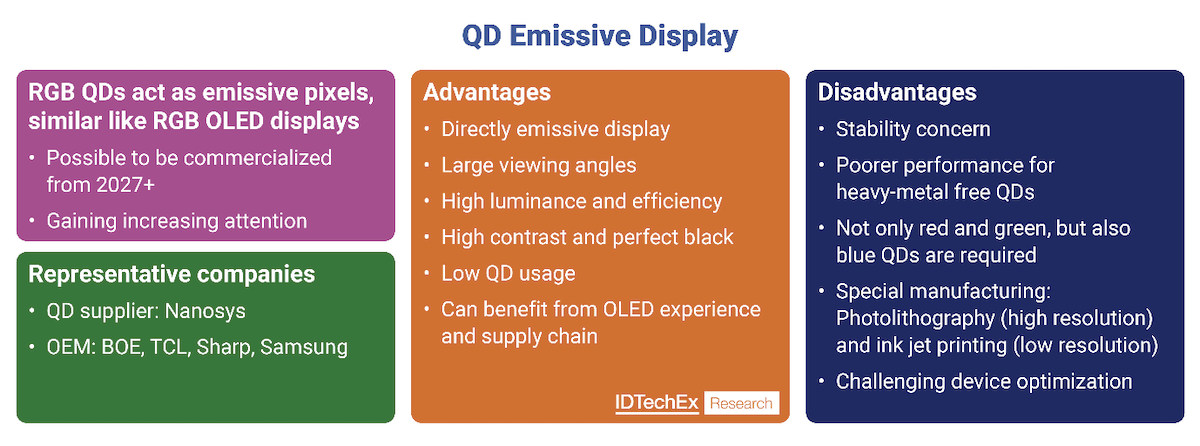
The reports suggests that Samsung Electronics is working closely with SAIT (Samsung's advanced research institute) and Samsung Display. QD-EL displays are similar to OLED displays, but they use quantum dots as the emitter material. This is the first display technology that uses the QD's electroluminescence, rather than the photoluminescence, used in color conversion for QD-LCDs, QD-powered microLEDs, and QD-OLEDs.

Read the full story Posted: Mar 20,2025

Avantama set to sell its perovskie quantum dot IP portfolio

Material developer Avantama announced that it is set to sell its entire perovskite QD IP portfolio. The company says that it has managed to bring the technology to market-readyness level, and is looking for a company that will bring it to market. 

Ocean Tomo Transactions (a part of J.S. Held) will be representing Avantama in the sale of its pQD IP portfolio. The company has developed over 220 IP assets, which includes patents on processes, compositions, formulations, films, and devices for the commercialization of semiconductor nanoparticle and quantum dot inks and films.

Read the full story Posted: Nov 13,2024

Researchers from Sungkyunkwan University developed a new QD-EL HTL material that significantly enhances the brightness and stability

Researchers from Sungkyunkwan University developed a source material for the inorganic hole transport layer of QD-EL devices. The researchers say that the new material significantly enhances the brightness and stability of emissive QD displays.

The researchers say that currently used organic HTL materials suffer from low conductivity and thermal instability. The new material is a standard HTL doped by defect-controlled nickel oxide-magnesium oxide alloy and treated with magnesium hydroxide. Using the new material, the EQE of the QD-EL device increased to 16.4%. The doping and treatment lowered the hole conductivity of the hole transport layer and suppressed the hole extraction process from within the quantum dots, thereby enhancing the device efficiency to a level comparable to existing technologies.

Read the full story Posted: Nov 02,2024

Researchers develop a highly efficient QD-EL device by identifying the presence of leakage electrons

Researchers from China's Southern University of Science and Technology, by simultaneously measuring the electroluminescence-photoluminescence, have identified the presence of leakage electrons in QD-EL devices, which leads to the discrepancy of the electroluminescence and the photoluminescence roll-off.

The researchers then developed a single photon counting technique, the enables them to detect the weak photon signals and thus provides a means to visualize the electron transport paths at different voltages. By reducing the amount of leakage electrons, the researchers developed a QD-EL device with an internal power conversion efficiency of over 98%.

Read the full story Posted: Sep 18,2024

Korean researchers use double-layer dry transfer printing to create highly efficient QD-EL displays

Researchers at Daegu Gyeongbuk Institute of Science and Technology (DGIST), Ulsan National Institute of Science and Technology (UNIST), and the Institute for Basic Science (IBS) have developed a new method, called double-layer dry transfer printing, to create highly efficiency QD-EL displays.

The researchers say that with the double-layer dry transfer printing technique, the light-emitting and electron-transferring layers of the device can be transferred onto a substrate simultaneously, which reduces interfacial resistance in the device, which facilitates electron injection and the control of leakage charge transport during the fabrication process. The researchers, by minimizing the leakage current, managed to increase the EQE of the QLED device to 23.3%, up from around 5% that is achieved with normal dry transfer printing. 

Read the full story Posted: Aug 30,2024

Samsung shows an inkjet-printed 18.2" QD-EL prototype

During Displayweek 2024, Samsung demonstrated its latest display prototypes, focusing mostly on flexible OLEDs, and QD-OLEDs.

The company also showed a 18.2" 3200x1800 (202 PPI) 250 nits QD-EL display, that was produced using an inkjet-printing process, based on cadmium-free QDs.

Read the full story Posted: May 22,2024

TCL CSoT shows a 14" inkjet printed QD-EL display, announced a $1 million prize to accelerate the technology

TCL CSoT demonstrated a 14" 2.8K inkjet-printed QD-EL display, that offers 30-120Hz VRR refresh rates and a 85% BT2020 color gamut. The impressive display won SID Displayweek's People's Choice Award.

TCL's CEO gave a keynote speech at Displayweek, saying how this is an early-stage technology that still has a lot of challenges before it can be commercialized - mainly the lifetime of the blue material. To encourage collaboration and innovation, TCL CSOT announced the Blue Star Project with a $1 million prize to incentivize collaboration and accelerate breakthroughs in QD-EL technology.

Read the full story Posted: May 19,2024

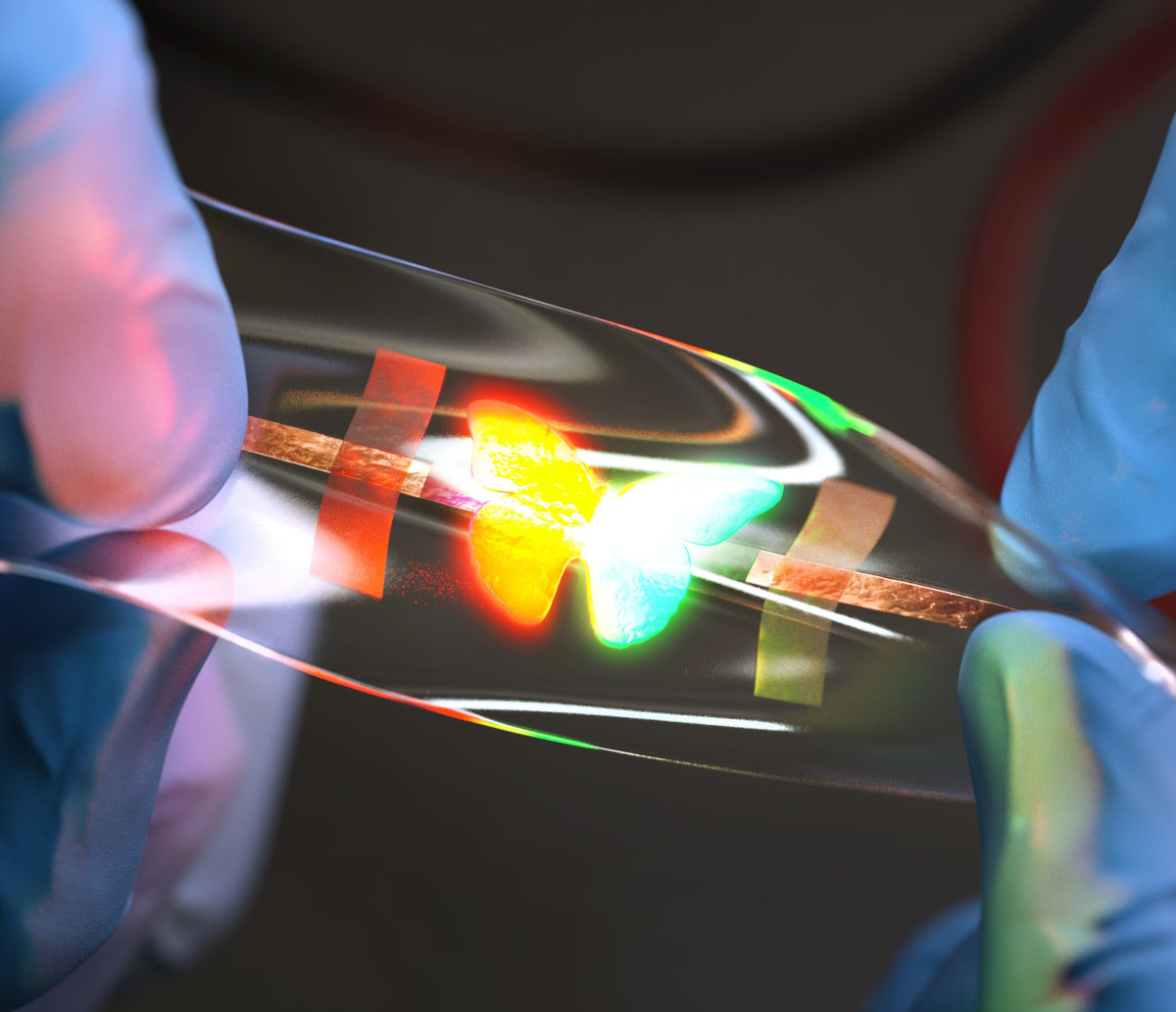
Researchers from the IBS in Korea developed intrinsically stretchable quantum dot LED displays

Researchers from Korea's Institute for Basic Science, led by Professor KIM Dae-Hyeong, published a new article in Nature that details intrinsically stretchable quantum dot LEDs. 

The researchers say that using current technology, making stretchable light-emitting devices results in poor luminous performance. The researchers now produced the intrinsically stretchable QD-LEDs using a mechanically soft and stretchable emissive layer consisting of a ternary nanocomposite of colloidal quantum dots, an elastomeric polymer and a charge transport polymer.

Read the full story Posted: Apr 16,2024